China Top Disposable Gowns What Materials Are Used?

Time:2026-11-16 Author:Aria
0%

Disposable medical gowns may look alike on a supplier’s product page, yet their materials affect comfort, fluid resistance, and intended use. For buyers comparing China’s leading disposable-gown suppliers, knowing what are the common materials used in disposable medical gowns is a practical starting point. Common options include spunbond polypropylene, SMS fabric, and nonwoven materials with polyethylene coatings. SMS combines spunbond layers with a meltblown middle layer; its feel and barrier performance depend on fabric weight, construction, and garment design. A coated gown may resist fluid penetration better, but it can also feel warmer during a long shift. Details matter.

Infection-prevention specialist Dr. William A. Rutala has emphasized matching protective measures to exposure risk. A cautious paraphrase of that principle is: “Choose gown protection according to the task and anticipated exposure.” This is not a material specification or a substitute for checking product documentation. Buyers should review stated barrier performance, seam construction, cuffs, sizing, and intended-use information. A gown that fits poorly can leave gaps at the wrists or back, even when its fabric appears substantial. Ask suppliers for test reports and clear material descriptions, then compare samples under realistic working conditions. Price and fabric names alone tell an incomplete story. That point is easy to overlook.
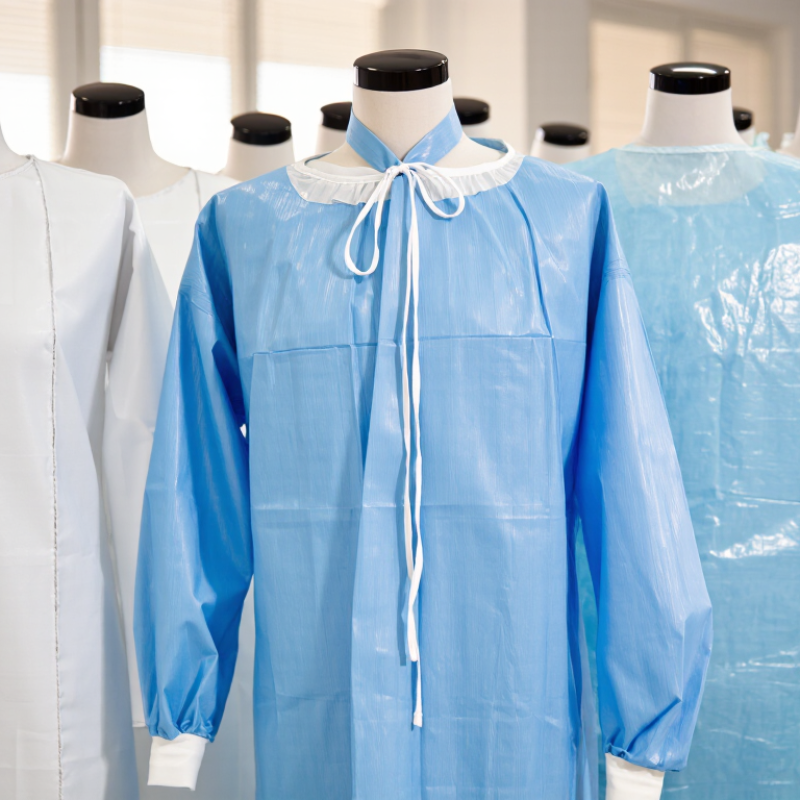
China Top Disposable Gowns What Materials Are Used?

Disposable Gown Materials: Polypropylene, SMS, PE Film, and Laminates

Disposable gowns are commonly made from polypropylene (PP), SMS, polyethylene (PE) film, or layered laminates. PP spunbond fabric is light and breathable, making it practical for routine, lower-fluid tasks. SMS combines spunbond layers with a meltblown middle layer, adding a barrier while retaining some airflow. It is not a magic shield. Fit, seams, and cuffs can still affect protection.

PE film creates a stronger liquid barrier, but it can feel warmer during extended wear. Laminates bond film to a nonwoven base, balancing fluid resistance with fabric flexibility; performance varies by construction. AAMI PB70:2022 classifies protective gowns using test results, not material names alone. Its Level 1 impact-penetration limit is 4.5 grams; Levels 2 and 3 require no more than 1 gram. Level 2 also requires a hydrostatic-pressure result of at least 20 cm of water, while Level 3 requires 50 cm. ASTM F1670 and F1671 provide methods for testing synthetic-blood and viral penetration. Check the finished gown’s test evidence and intended use. A material label by itself tells only part of the story.

Disposable Gown Materials: Typical Construction Layers

A structural comparison of polypropylene spunbond, SMS, PE film, and laminated materials.

SMS is made with a spunbond–meltblown–spunbond structure. A single spunbond web and a PE film are each shown as one layer. Laminates contain at least two bonded layers; their actual construction varies by product. Layer count alone does not indicate protection level.

SMS Construction: How Spunbond and Meltblown Layers Form Barriers

China Top Disposable Gowns: What Materials Are Used?

SMS Construction: How Spunbond and Meltblown Layers Form Barriers

SMS fabric combines three layers: spunbond, meltblown, and spunbond. The outer spunbond layers add strength and help the gown resist everyday handling. Inside, the meltblown layer uses very fine fibers to help slow the passage of small particles and fluid droplets. That middle layer matters. The layers are bonded into one lightweight material, rather than stitched together like separate panels.

In a disposable gown, this structure can balance coverage, flexibility, and breathability. The spunbond surfaces usually feel smoother and more durable, while the meltblown center contributes to the barrier. Still, SMS is not a guarantee of protection against every exposure. Fabric weight, seams, closures, and test results all affect how a gown performs. A gown can look sturdy and still have limits. That detail is easy to overlook.

Tips: Match the gown’s stated barrier level to the task, and check its seams and cuffs for gaps. If a label is unclear, ask for test information. Don’t judge protection by fabric feel alone.

AAMI PB70 Levels 1–3: Impact Penetration Limits of <4.5 g and <1.0 g

Disposable gowns may use spunbond polypropylene, SMS nonwoven fabric, or coated materials. Their barrier performance depends on construction, seams, and the tested gown area. Fabric names alone do not show how much fluid a gown can resist.

AAMI PB70 classifies gowns by liquid-barrier performance. In the AATCC 42 impact penetration test, Level 1 allows no more than 4.5 g of water penetration. Levels 2 and 3 allow no more than 1.0 g. The tighter limit matters. A gown sample is exposed to a measured spray, then the water passing through is weighed. Level 3 also has a higher hydrostatic-pressure requirement than Level 2, so the impact test alone cannot distinguish their full performance.

Look closely at the label and the test documentation. Small details matter. A gown’s rating applies to specified areas and test conditions; it does not guarantee protection in every procedure. For example, a lightweight nonwoven gown may suit low-fluid tasks, while a coated or multilayer gown may be selected when greater fluid exposure is expected. Fit, movement, and damaged seams can still affect real-world performance. Standards help compare products, but they cannot replace a task-specific risk assessment. That part is easy to overlook.

Level 3 Testing: AATCC 127 Requires Hydrostatic Pressure Above 50 cm

China Top Disposable Gowns: What Materials Are Used?

Level 3 Testing: AATCC 127 Requires Hydrostatic Pressure Above 50 cm

Disposable gowns commonly use spunbond polypropylene, SMS fabric, or polyethylene-film laminates. Material choice affects breathability, seam strength, and liquid resistance. But fiber names alone do not establish protection.

For Level 3, ANSI/AAMI PB70:2022 specifies a hydrostatic-head result of at least 50 cm of water using AATCC TM127. The standard also sets an impact-penetration limit of 1.0 g or less under AATCC TM42. A 50 cm water column equals roughly 4.9 kPa. AATCC TM127 describes the test method; PB70 defines the Level 3 threshold. During testing, water pressure rises against a fabric sample until penetration occurs. The result applies to the sample tested, not automatically to every seam or gown opening.

Small but important. A passing fabric swatch does not prove that a finished gown performs identically. Ask for current test reports and check that the tested material matches the supplied gown. CDC’s 2020 guidance on isolation gowns advises choosing protection according to the task and expected exposure. Real wear also adds movement, abrasion, and fit variation. The number matters, but construction matters too.

China Top Disposable Gowns What Materials Are Used? - Level 3 Testing: AATCC 127 Requires Hydrostatic Pressure Above 50 cm
Material or Construction Typical Structure Common Gown Use Fluid-Barrier Considerations Level 3 Testing Context
Spunbond polypropylene (PP) Continuous polypropylene filaments bonded into a nonwoven sheet. Basic isolation gowns and other low-fluid-exposure applications. Provides a lightweight fabric, but a basic spunbond sheet should not be assumed to provide the barrier performance needed for higher fluid exposure. Material name alone does not establish a protection level. The applicable gown areas must meet the relevant finished-product performance requirements.
SMS polypropylene Spunbond–meltblown–spunbond layers; the meltblown layer is placed between spunbond layers. Disposable gowns where a balance of breathability, strength, and barrier performance is desired. The meltblown layer can improve resistance to liquid penetration, but performance varies with fabric design, seams, and garment construction. SMS is a construction type, not a Level 3 certification. Verify test results for the required gown zones.
Polypropylene with a polyethylene (PE) film layer Nonwoven PP laminated or coated with a continuous PE film, often in selected gown panels. Gowns intended for areas with greater potential for fluid contact. The film layer can increase liquid-barrier performance; it may also reduce air and water-vapor transmission compared with uncoated nonwoven fabric. Hydrostatic resistance must be assessed using the specified test method. Garment seams and other construction details also affect protection.
Microporous film laminate A microporous polymer film bonded to a nonwoven backing. Selected protective gown designs requiring a liquid barrier with some water-vapor transmission. Barrier performance depends on the film, laminate quality, and garment design; “microporous” alone does not define a particular protection level. Use product-specific test data rather than inferring a Level 3 rating from the material description.
Coated nonwoven fabric Nonwoven substrate with a polymer coating applied to one or both sides. Gowns designed for applications where a coated surface is needed in specified areas. The coating can form a liquid barrier, while breathability and flexibility depend on the coating and substrate. Test the gown’s relevant zones and construction; a coating by itself is not proof of compliance.
Level 3 hydrostatic-pressure criterion Performance criterion applied to the applicable critical zones of a surgical gown under ANSI/AAMI PB70. Used to classify gowns intended for moderate risk of fluid exposure. Hydrostatic pressure is reported as the height of a water column, in centimetres of water (cm H₂O). For Level 3, the hydrostatic-pressure requirement is at least 50 cm H₂O, tested using AATCC 127. AATCC 127 describes the test method; the Level 3 classification criterion comes from ANSI/AAMI PB70.
Important: A fabric or material description cannot confirm that a gown is Level 3. Classification depends on the applicable standard, test results for the required gown areas, and garment construction. The Level 3 threshold is at least 50 cm H₂O, not simply a claim that a material is “water resistant.”

Level 4 Gowns: ASTM F1671 Tests Resistance to Viral Penetration

Disposable gowns are commonly made from polypropylene spunbond-meltblown-spunbond fabric, polyethylene-coated nonwovens, or other laminated materials. Their layers affect fluid resistance, breathability, and tear strength. For a Level 4 gown, however, the material name alone proves little. The finished barrier material must meet the applicable performance tests.

ANSI/AAMI PB70 classifies Level 4 as the highest liquid-barrier level. ASTM F1671 tests resistance to viral penetration using Phi-X174 bacteriophage, roughly 27 nanometers across, under a 2 psi pressure challenge. This is a laboratory test, not a promise that a gown prevents infection in every clinical situation.

That distinction matters.

Seams, closures, wear, and fit can affect protection during use, even when tested material passes. Check that the product documentation identifies ASTM F1671 and the tested gown areas; a vague “viral resistant” claim is not equivalent.

Standards measure defined conditions. Real work is messier.

FAQS

What materials are commonly used for disposable gowns?

Common options include polypropylene spunbond, SMS, polyethylene film, and layered laminates. Each balances airflow and liquid resistance differently. No fabric does everything.

How does SMS differ from polypropylene spunbond?

Polypropylene spunbond is light and breathable for routine, lower-fluid tasks. SMS adds a meltblown middle layer for extra barrier protection while retaining some airflow. Not a magic shield.

What is the tradeoff with polyethylene film?

PE film provides a stronger liquid barrier, but it may feel warmer during extended wear. That can matter during a long shift.

Do material names alone show how protective a gown is?

No. AAMI PB70 classification depends on test results, not material names alone. Seams, cuffs, closures, and fit also affect protection. Labels tell only part.

What do AAMI PB70 Levels 1, 2, and 3 measure?

Level 1 allows up to 4.5 grams in the impact-penetration test. Levels 2 and 3 allow no more than 1 gram. Level 2 requires at least 20 cm of water in hydrostatic pressure testing. Level 3 requires at least 50 cm.

What does ASTM F1671 test?

It tests resistance to viral penetration using Phi-X174 bacteriophage, about 27 nanometers wide, under a 2 psi pressure challenge. It is a laboratory test. Not a guarantee.

What makes a Level 4 gown different?

AAMI PB70 identifies Level 4 as its highest liquid-barrier level. The finished barrier material must meet applicable performance tests. The material name alone proves little.

What should gown documentation identify?

Check for ASTM F1671 results and which gown areas were tested. A vague “viral resistant” claim is not equivalent. It is easy to overread a clean test result; real work is less tidy.

Conclusion

Understanding what are the common materials used in disposable medical gowns helps explain how gowns balance protection, comfort, and cost. Common options include polypropylene, polyethylene (PE) film, SMS fabric, and multilayer laminates. SMS combines two spunbond outer layers with a meltblown middle layer: the spunbond layers provide strength, while the fine meltblown fibers help block liquid and particles. PE film and laminates can add a stronger liquid barrier, depending on the gown’s intended use.

Protection is also described through AAMI PB70 levels. Levels 1–3 use increasing performance requirements, including impact-penetration limits of less than 4.5 g and, for stricter criteria, less than 1.0 g. Level 3 testing includes the AATCC 127 hydrostatic-pressure method, with a requirement above 50 cm. Level 4 gowns are assessed using ASTM F1671 to test resistance to viral penetration. Material choice and construction therefore determine how a gown performs under specific test conditions.

Aria

Aria

Aria is a dedicated marketing professional with a deep passion for innovative strategies and a keen understanding of our company's product offerings. With a wealth of experience in the industry, Aria excels at crafting engaging content that highlights the unique features and benefits of our......